New Paper Published: Tim Higgins Leads Study Generating a 1,000-Member Diffusion Ensemble for Atmospheric River Forecasting
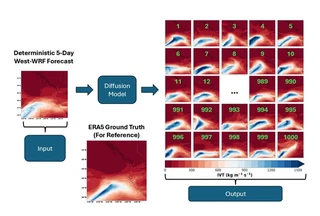
We are delighted to share that a new paper led by Dr. Timothy B. Higgins — a former PhD student in the group, now a postdoctoral research associate — has been published in the American Meteorological Society journal Artificial Intelligence for the Earth Systems.
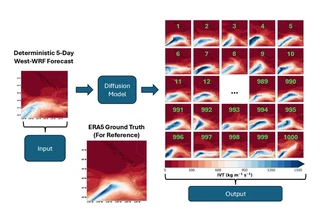
Generating a 1,000-Member Ensemble with Diffusion
The paper, “Generating a 1000-Member Ensemble of Integrated Water Vapor Transport Forecasts with Diffusion,” tackles a long-standing bottleneck in probabilistic weather prediction: traditional ensemble systems are so computationally expensive that operational centers can only afford to run a small number of perturbed simulations, limiting how well forecasters can characterize the risk of extreme events.
Tim and coauthors instead use diffusion, a form of generative AI, to expand a single deterministic forecast from the West Coast-focused West-WRF model into a full 1,000-member ensemble of integrated water vapor transport (IVT) over the North Pacific — at a fraction of the computational cost of a traditional dynamical ensemble.
Evaluated against binned rank histograms, continuous ranked probability score, spread-to-error ratio, reliability diagrams, and Brier skill scores, the diffusion ensemble outperforms operational ensembles from both the Global Ensemble Forecast System (GEFS) and the European Centre for Medium-Range Weather Forecasts (ECMWF). The authors also show that the ensemble produces realistic, high-quality representations of real extreme events — a promising sign for its use in operational risk assessment.
A Collaborative Effort
The study was coauthored by Dr. Timothy B. Higgins, William E. Chapman (NCAR), Dr. Aneesh Subramanian (University of Colorado Boulder), and Dr. Luca Delle Monache (CW3E / Scripps Institution of Oceanography), building on Tim’s dissertation work and his time in the Advanced Study Program at NCAR.
This publication formalizes the diffusion-based approach that already underpins the operational ensemble forecasting system now live at the Center for Western Weather and Water Extremes (CW3E) — see our earlier announcement about that launch.
View the Live Model Forecasts
View the live operational diffusion ensemble forecasts on the CW3E website
Congratulations to Tim and the entire team on this well-earned publication!
